
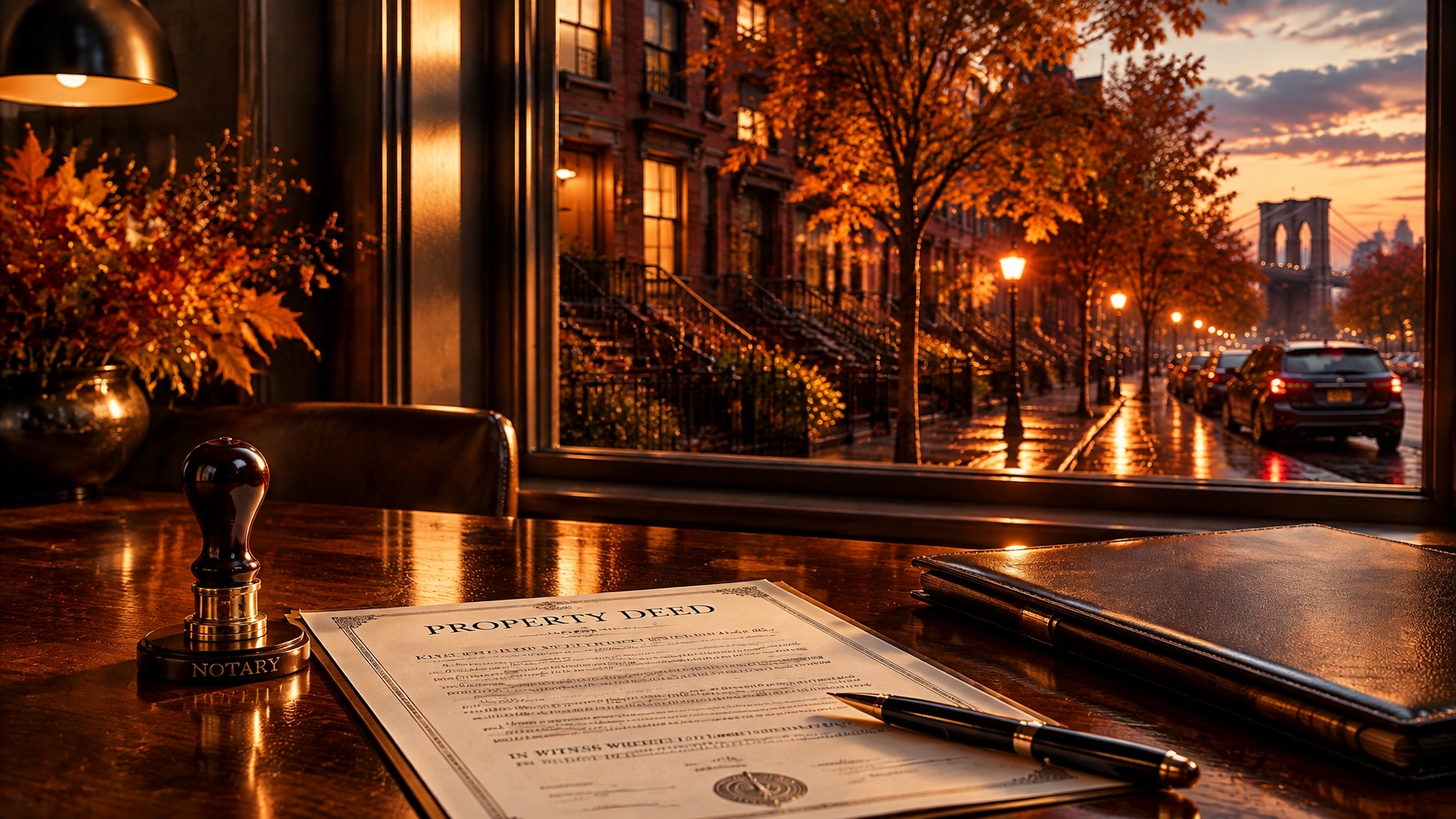
What if a deed was filed on your family home while your mother was in rehab? What if the paper looked real, the notary stamp looked real, and the person on a video call was not real at all? That is why people like you and me (notaries need notaries too) search for a trusted notary public in New York City. Think of a family in East New York. They got a notice that a quit claim deed had been filed on their mother’s house. The paper used a notarized power of attorney nobody in the family ever signed. It feels like a nightmare. And for families facing deed theft, it is.
Why a Stamped Paper Can Steal a House
A notary stamp can make a document look official. But a stamp does not prove that the signer was honest. It does not prove that the signer owned the home. It does not prove that the paper was understood.
The person checking ID is the first line of defense.
On October 6, 2026, Bloomberg Law reported that AI is “supercharging” deed theft. Criminals can scan property records, find empty homes or older owners, create fake deeds, forge powers of attorney, and copy notary stamps. Some even use fake faces during remote online notary signings.
New York deed theft complaints have tripled in recent years. The city created the Mayor’s Office of Deed Theft Prevention in April 2026. The office works with the Department of Finance, the Sheriff’s Office, and other agencies. New York also paused tax lien sales for six months while the city reviewed the system.
The New York Attorney General announced the first indictments under the state’s 2023 deed theft law in 2025. In June 2026, the Attorney General Letitia James charged a man accused of stealing the home of a 92-year-old woman with dementia.
The lesson is simple: A forged notary stamp can help a fake deed pass a quick paper check. A careful notary slows the process down. That pause can protect a family’s home.
How to Check Your NYC Property Records for Free
You do not need to wait for a strange letter to check your deed. You can review your property records through ACRIS, the city’s Automated City Register Information System.
Use the NYC Department of Finance ACRIS property records system. The basic steps are:
- Open the ACRIS search page.
- Search by your property address, borough, block, and lot.
- Review the deed and other recorded documents.
- Check the owner names, dates, signatures, and document types.
- Save a copy of anything that looks wrong.
- Sign up for the city’s Notice of Recorded Document service when available. Homeowners, and their trusted friends or family, can get an email or text alert the day after a deed or mortgage document is recorded against their property.
- Report a suspicious filing to the NYC Department of Finance and ask for help from the Sheriff’s Office.
Look for documents you do not know about. These may include:
- A new deed.
- A power of attorney.
- A mortgage or loan.
- A satisfaction or release.
- A transfer to a company or stranger.
- A filing made while the property owner was in a rehab center, hospital, jail, or out of town.
The city’s new Office of Deed Theft Prevention is meant to improve public help, flag suspicious filings, and coordinate with law enforcement. You can also call NYC 311 for city service help.
If you think a deed was stolen, do not confront a suspected scammer alone. Some scammers are ruthless and you don’t want to end up on News 12 Bronx for trying to defend property. Your life and health are of infinitely more value. Do not sign new papers just because someone says it will “fix” the problem. Save every letter, email, text, and document. Then contact a real estate attorney or legal aid. Fast action matters.
What a Real Notary Public New York City Signing Looks Like
A real notary public in New York City isn’t a run of the mill service. The notary should pay attention to the person, the paper, and the situation.
A careful notary will usually:
- Ask for proper, unexpired government photo ID.
- Compare the ID to the signer’s face.
- Compare the signer’s name to the document.
- Make sure the signer appears willing.
- Refuse a signer who is being coached.
- Refuse a signer who cannot communicate with the notary.
- Refuse to notarize a blank space.
- Record the date and place of the notarization in his/her journal.
- Complete the notarial certificate correctly.
- Stop if the facts do not make sense.
A signer should not be rushed. A stranger should not answer every question for the signer. A caregiver, family member, broker, or agent cannot simply take over the signing.
A notary also cannot give legal advice. A notary cannot tell you what a deed, trust, or power of attorney means although a good notary, who’s worth their salt should be able to point you to where you can find those answers. If you don’t understand the document, stop and ask a qualified legal professional.
The National Notary Association explains the basic role of notaries and the limits on what they can do. The goal is not to create fear. It is to give you peace of mind and respect at the table.

Mobile Notary NYC Visits Where You Need Them
A safe signing does not always happen in an office. Our mobile notary NYC team comes to you.
We visit:
- Bedside rooms and rehab centers.
- Kitchen tables from Bay Ridge to Dyker Heights.
- Homes from Sunset Park to East New York, even Bushwick.
- Co-op and condo board signings from Breezy Point to Co-Op City.
- Offices in Midtown and the Financial District.
- Correctional facilities anywhere in New York.
- Hospitals, care centers, and private residences.
Our mobile notary public services cover all five boroughs. We serve Astoria, Jackson Heights, Flushing, Riverdale Fieldston, Co-op City, Harlem, Washington Heights, Inwood, St. George, Todt Hill, Long Island City, Coney Island, and the Rockaways, just to name a few.
Whatever the weather or the threat, our notary signing agents are on call. During fall closing season, and busy times when people need to finish there paperwork indoors. Snowbird owners heading to Florida may need help before leaving a vacant house behind. Co-op boards and condo managers may need documents signed on a tight schedule.
Our network of 500+ mobile notary apostille agents are NNA-certified and background screened. We also carry $1 million in Errors and Omissions and Cyber Liability coverage. Our receptionist Rachel is available to take your call, and we can meet you anywhere in the Big Apple from 7 AM to 11 PM Sunday to Thursday and 7 AM to 6 PM on Fridays. Learn more about us at sealingtimemobilenotaries.com/about.
Most important, we’re vigilant. We trust but verify, every step of the way, especially if something feels odd. We may say no. That isn’t rude. Its courtesy, safety, and respect. It’s loving our neighbors in practice.
Book a mobile notary or free consultation.
Online Notary New York: Two Rules People Get Wrong
A remote online notary New York session can be helpful. But it is not right for every document.
Rule one: The notary must be in New York
Under New York’s electronic notarization law, the notary must be physically standing (or sitting) in New York State during the online session. The signer may be in Florida, Portugal, South Korea, or another location, but the notary must be in New York.
That is one reason to ask where the notary is located. A website may say “online notary service,” but you still need a qualified notary following New York rules.
Rule two: Some documents are excluded
New York Executive Law § 135-c allows electronic notarization for many documents. You can read the law at NY Senate Executive Law § 135-c.
The most common document the cannot be notarized online is a vehicle title, which our neighbors to the West in PA get notarized all the time. If uncertain whether your document qualifies for the world’s most convenient method of notarization, hands down, please consult the intended recipient of the documents before booking.
For this deed theft topic, the point in regards to security is plain. Remote online notary signings may not be the best tool for a New York deed, unless you’re immobile or in custody, in which case for around a hundred dollars more, you should have a mobile notary meet you for an in-person, wet ink signing.
If you need estate planning help before notarization, you can review USLegalWills.com online legal wills. That service is separate from our notary work. A legal professional can help you decide what document you need.

Apostille Birth Certificate and Family Papers for Owners Abroad
If a homeowner lives abroad, the order of operations matters:
- Get the correct original or certified copy of the document.
- Complete the required notarization, if applicable.
- Get county clerk certification when required.
- Submit the document for the apostille.
- Get a certified translation if the destination country requires one.
For an apostille birth certificate, check the record type first. New York State Department of Health vital records generally do not need county clerk certification before the apostille. See the New York State Department of Health vital records apostille guidance.
A translation does not replace an apostille. An apostille does not replace a translation.
If a foreign language record must be translated, you can review certified translations for immigration and legal needs. Ask the receiving country or agency what format it wants.
For an owner living outside the United States, ExpatLegalWills.com online expatriate legal wills may also be useful for estate planning. Again, that is separate from our notarization and apostille service.
You can request help with an apostille or apostille birth certificate, and we can help you understand the next paperwork step.
FAQ: Apostille and Notary Questions NYC Homeowners Ask
“Who’s the best notary public near me?”
The best notary public near me is a qualified person who checks ID, follows New York rules, explains the process without giving legal advice, and is willing to stop when something feels wrong. Look for NNA certification, background screening, at minimum $100K E&O coverage, clear pricing, and real customer reviews. Sealing Time Mobile Notaries / Notary Apostille Agents has 3,000 plus happy clients i.e. major global law firms like Baker McKenzie to mom and pop title and escrow companies like Iconic Title & Escrow, nearly 500 verifiable 5-star reviews, and carries a $1M policy, offering you 10-40 times more protection than 99% of New York notaries.
“Can someone notarize a deed for me if I am not there?”
Usually, no. The signer must appear before the notary in the way New York law allows. A person cannot sign for you just because they have a copy of your ID. A power of attorney may allow someone to act for you in some settings, but that is a legal question and should be directed to a qualified legal services provider.
“Can I get a notarized power of attorney through a mobile notary service?”
A mobile notary can meet you at a home, hospital, or rehab center and notarize a power of attorney when the document and law allow it. The signer must be present, willing, and able to communicate. In New York, a power of attorney is not a document to rush through an online session. Ask a lawyer to prepare or review it first.
“Is an AI forged notary stamp easy to spot?”
Not always. A forged stamp may look clean and official. That is why the signer check matters more than the ink. We review the identity, the person’s willingness, the date, the place, and the full story. Mindful paper review and direct contact with the owner can catch what a stamp cannot.
“How much does an apostille cost in New York?”
The New York Department of State fee is $10 per document. You may also have to pay for county clerk certification, shipping, document retrieval, mobile notary work, and/or translation. If you prefer to have a notary apostille agent handle it all for you, it’ll cost you a couple hundred dollars, or more depending on their expertise and the complexity of your order. Always ask for a full estimate before you start.
“Do I need the county clerk before the apostille?”
Notarized documents generally need county clerk certification in the county where the notary is qualified before the Department of State will issue the apostille. New York State Department of Health vital records generally do not need county clerk certification. Rules can depend on the document type, so check the Department of State instructions.
Protect Your Home, Your Family, and Your Peace of Mind
A family should not have to discover a stolen deed after the fact. Maybe you are helping your mother in East New York. Maybe you are preparing a power of attorney before a winter trip. Maybe you are an owner in Portugal trying to protect a New York home. Together, we can slow the paperwork down and check each step with care.
Call today for a free consultation. Tell us what document you have, where you are located, and where it must be used. We will help you find the next safe step. Sometimes hope starts with one careful ID check, one honest question, and one person willing to say, “Lets not rush this.” Yours too can end with the right paper in the right hands.
Contact Sealing Time for a free consultation.
Affiliate disclosure: Some links in this article are affiliate links. If you use one, we may receive a commission at no extra cost to you. We only include these links when they may fit the document or planning need discussed.